What Permeance Means
Permeance is the rate at which water vapor passes through a material, measured in perms. Lower perms means more resistance to vapor.
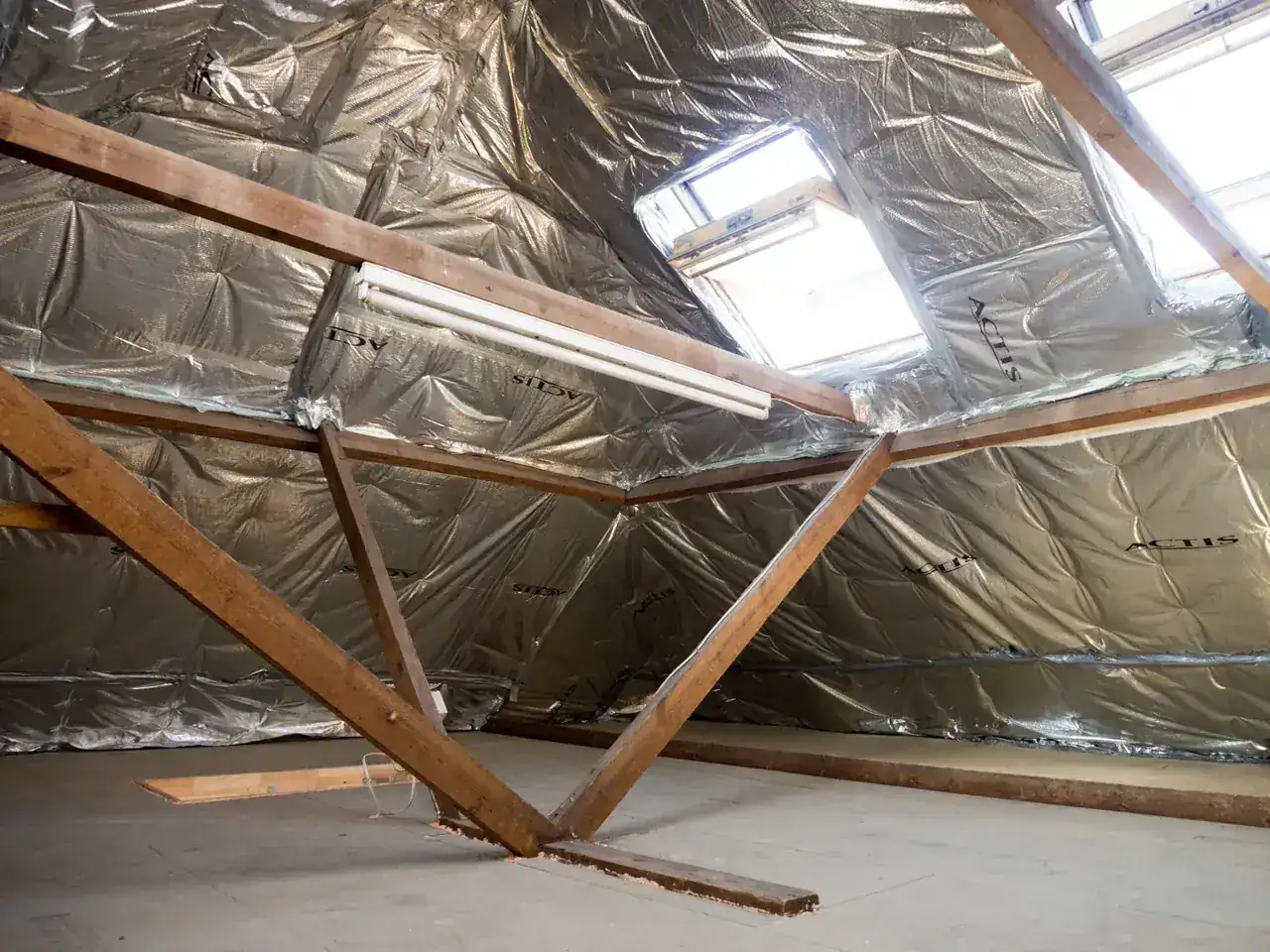
The three classes are defined by perm rating: Class I is 0.1 perm or less (polyethylene sheet, foil facing) — these are true vapor barriers that nearly stop diffusion. Class II is 0.1 to 1.0 perm (the kraft paper facing on a faced batt, or certain smart membranes). Class III is 1.0 to 10 perm (standard latex paint on drywall). A material that lets vapor pass freely above 10 perms is vapor-open, like housewrap.
Why the Warm Side Rule Exists
Vapor moves from warm-humid toward cold-dry. In a Massachusetts winter, that direction is outward.
Indoor air in winter is warmer and more humid than the outdoor air; vapor drives outward through the wall toward the cold sheathing. If it reaches a cold surface below its dew point, it condenses inside the wall. Placing the vapor retarder on the interior (warm) side slows vapor before it reaches the cold sheathing, which is why kraft-faced batts are installed facing the room and poly, when used, goes behind the drywall — never on the exterior of a cold-climate wall, where it would trap inward-driven summer vapor.
Which Class Goes Where
The correct class depends on the assembly and what other materials are managing vapor.
| Assembly | Typical retarder | Class |
|---|---|---|
| Standard insulated wall | Kraft-faced batt or latex paint | II or III |
| Wall with exterior rigid foam | Latex paint only (interior) | III |
| Closed-cell spray foam wall | None needed — foam is the retarder | — |
| Basement wall (rigid foam) | Foam controls vapor; no poly | — |
| Vaulted ceiling | Smart membrane or kraft | II |
The recurring mistake is doubling up — exterior rigid foam plus interior polyethylene creates a wall that cannot dry in either direction. When exterior foam or closed-cell spray foam is present, the interior finish should stay vapor-open (Class III paint) so any incidental moisture can dry inward.
The Basement Exception
Below grade, the old polyethylene approach causes problems.
Concrete foundations are permanently damp and drive vapor inward year-round. Polyethylene against a basement wall traps that moisture and grows mold behind it. The modern approach is rigid foam or closed-cell spray foam applied directly to the concrete, which insulates and manages vapor without a separate poly layer. See our basement insulation approach for the assembly detail.
What a Smart Vapor Retarder Does
Newer membranes change permeance with humidity.
A smart vapor retarder is tight in winter (low perm, blocking outward drive) and opens up in summer (higher perm, allowing inward drying). In a Massachusetts climate that swings between heating and cooling seasons, this two-way behavior lets a wall dry in whichever direction it needs to, which a fixed polyethylene sheet cannot do. They are most useful in vaulted ceilings and double-stud walls where drying capacity is limited.
Frequently Asked Questions
Which side does the vapor barrier go on in Massachusetts?
Do I need a vapor barrier with spray foam?
What is the difference between Class I, II, and III vapor retarders?
Why is polyethylene bad in a basement?
Can a wall have two vapor barriers?
What is a smart vapor retarder?
References & Sources
- Massachusetts 780 CMR energy codes. https://www.mass.gov/info-details/massachusetts-energy-codes
- Mass Save insulation and air sealing. https://www.masssave.com/residential/rebates-and-incentives/insulation-and-air-sealing